
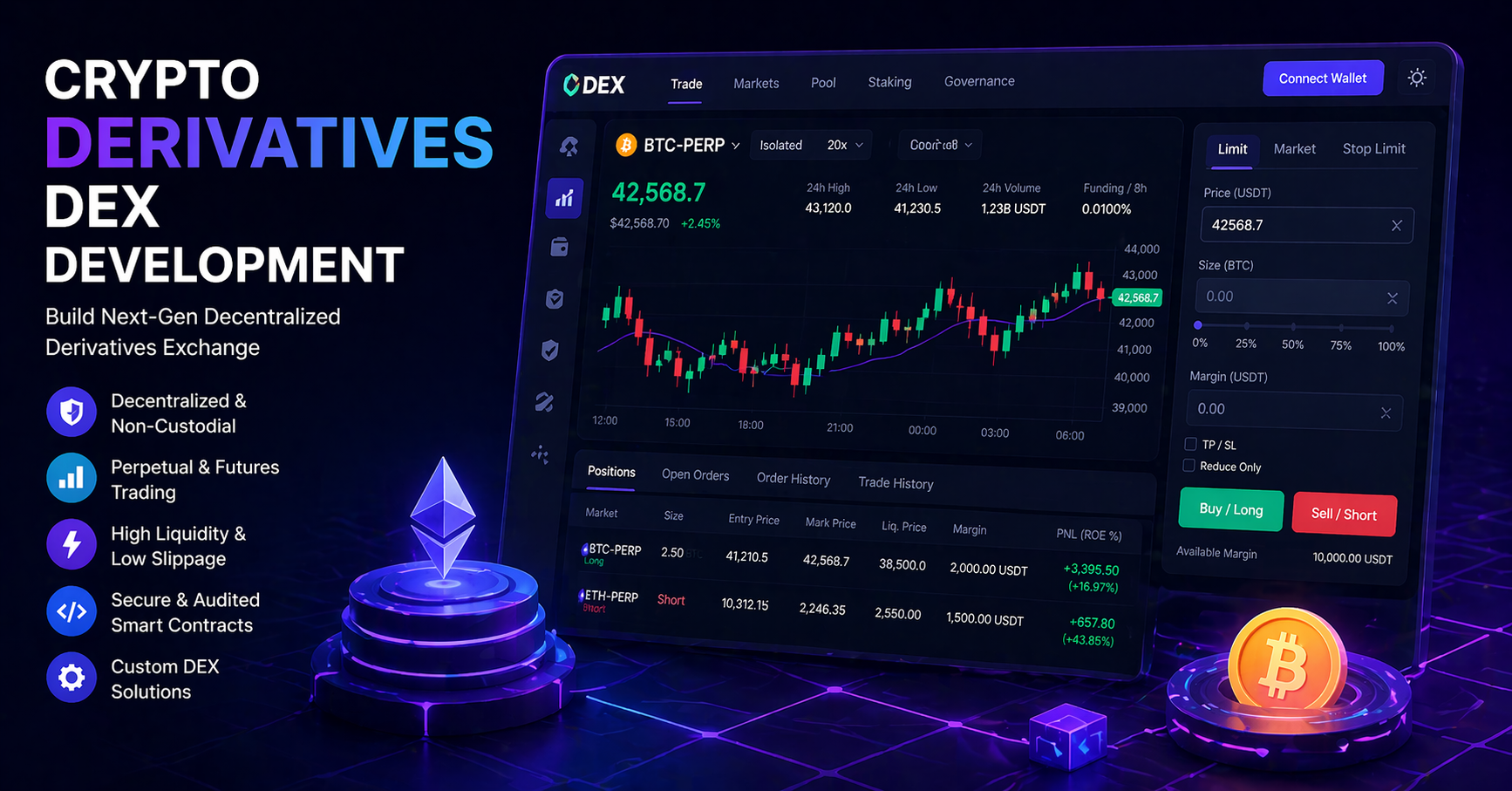
In Q2 2026, decentralized derivatives exchanges (DEXs) reached a massive milestone—$898 billion in trading volume. This surge reflects a major shift in how traders interact with financial markets. Instead of relying on centralized platforms, users are moving toward decentralized systems that offer transparency, control, and advanced trading features.
This rapid growth has created strong demand for crypto derivatives DEX development, as businesses aim to build platforms that support high-frequency trading, leverage, and global participation without intermediaries.
The Rise of Derivatives DEXs in 2026
Derivatives trading has always been a cornerstone of financial markets. In the crypto space, it has grown even faster due to volatility and demand for leverage.
In 2026, decentralized derivatives platforms evolved significantly. They now offer advanced tools like perpetual futures, options trading, and margin systems—all without requiring users to trust a centralized authority.
This evolution is powered by innovations in blockchain scalability, smart contract efficiency, and liquidity management. Traders are choosing DEXs because they provide full custody of funds and eliminate risks associated with centralized exchanges.
Why $898B Volume Was Achieved
Several factors contributed to the explosive growth in derivatives DEX trading volume.
First, leverage trading became more accessible. Users can open large positions with relatively small capital, increasing trading activity.
Second, improved user experience made decentralized platforms easier to use. Modern interfaces now rival centralized exchanges in speed and simplicity.
Third, institutional participation increased. More professional traders and funds are entering DeFi, bringing significant liquidity.
Another key factor is the integration of advanced futures trading platform creation, enabling seamless execution of perpetual contracts and leveraged trades.
Understanding Crypto Derivatives DEXs
A derivatives DEX allows users to trade contracts based on the value of underlying assets rather than the assets themselves.
These contracts include futures, options, and perpetual swaps. Traders can speculate on price movements, hedge risks, or amplify gains using leverage.
Unlike centralized platforms, DEXs use smart contracts to manage trades, collateral, and settlements. This ensures transparency and reduces counterparty risk.
The Role of Options and Futures in Growth
Options and futures are the backbone of derivatives trading. They provide flexibility and risk management tools for traders.
Platforms focusing on options protocol development enable users to create and trade options contracts with customizable parameters. This adds depth to the trading ecosystem.
Similarly, strong futures trading infrastructure allows for perpetual contracts, which have become one of the most popular instruments in crypto trading.
These features attract both retail and institutional traders, significantly increasing platform volume.
Key Features of a Successful Derivatives DEX
To compete in 2026, a derivatives DEX must offer more than basic trading functionality.
Liquidity is critical. Deep liquidity ensures tight spreads and efficient trade execution. Many platforms use liquidity pools or market makers to maintain stability.
Risk management tools are also essential. Features like liquidation engines, margin requirements, and insurance funds protect both traders and the platform.
Speed and scalability matter. High transaction throughput and low latency improve user experience and support high-volume trading.
Security remains a top priority. Smart contracts must be thoroughly audited to prevent exploits.
A well-designed decentralized derivatives exchange combines all these elements to create a robust trading environment.
Development Blueprint for Derivatives DEX
Building a derivatives DEX requires a structured approach.
The first step is defining the trading model. Decide whether the platform will support perpetual futures, options, or a combination of both.
Next, design the smart contract architecture. This includes trade execution logic, collateral management, liquidation mechanisms, and fee structures.
Liquidity management is another key component. Developers must integrate liquidity pools or market-making systems to ensure smooth trading.
The user interface should be intuitive and responsive, offering advanced charts, order books, and trading tools.
Finally, the platform must undergo rigorous testing and auditing to ensure security and performance.
Challenges in Crypto Derivatives DEX Development
Despite the opportunities, building a derivatives DEX comes with challenges.
Liquidity fragmentation can affect trading efficiency. Without sufficient liquidity, users may experience slippage and poor execution.
Smart contract complexity increases risk. Derivatives platforms involve advanced logic, making thorough testing essential.
Regulatory uncertainty is another factor. Different regions have varying rules for derivatives trading, which can impact platform operations.
However, these challenges can be addressed with proper planning and technical expertise.
Why 2026 Is the Right Time to Build
The derivatives market is expanding rapidly. More traders are entering the space. Institutional interest is growing. Blockchain technology is more scalable than ever.
At the same time, users are demanding decentralized solutions that offer transparency and control.
This creates a perfect environment for launching new derivatives DEX platforms.
Businesses that invest in crypto derivatives DEX development now can capture significant market share and position themselves as leaders in the next phase of DeFi evolution.
Future of Derivatives DEXs
The future of derivatives DEXs looks promising. Innovations in Layer 2 scaling, cross-chain interoperability, and AI-driven trading tools will further enhance platform capabilities.
We can expect more advanced financial instruments, improved risk management systems, and greater institutional adoption.
As the market matures, derivatives DEXs will likely become a core component of the global financial system.
Final Thoughts
The $898B trading volume achieved in Q2 2026 highlights the massive potential of decentralized derivatives platforms.
For entrepreneurs and developers, crypto derivatives DEX development is more than an opportunity—it is a gateway to the future of trading.
The market is growing.
The demand is rising.
Now is the time to build.















0 Comments