
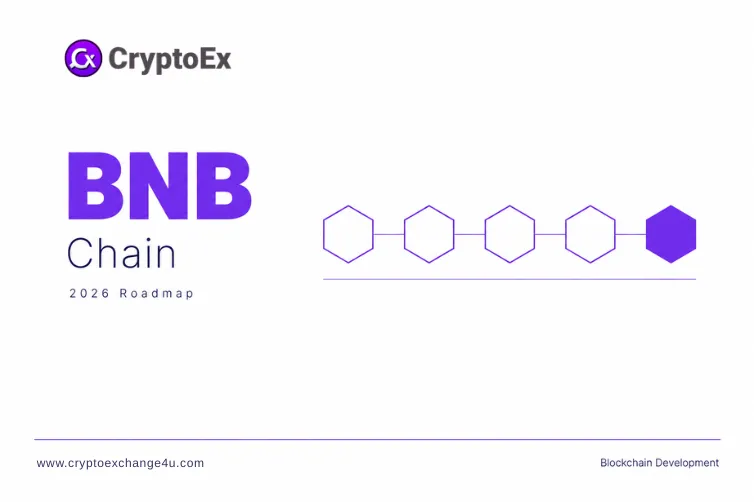
If you’re an entrepreneur or investor evaluating blockchain infrastructure for your next Web3 venture, BNB Smart Chain (BSC) deserves a serious look — especially right now. The network just closed 2025 with zero downtime, record transaction volumes, and a series of hard fork upgrades that have fundamentally changed what’s possible on the chain. In 2026, it’s continuing that trajectory aggressively.
Let’s break down what makes BSC compelling, where its real limitations lie, and what the 2026 roadmap means if you’re planning to build.
Why BSC Still Wins on Performance and Cost
BSC’s core appeal has always been the combination of low transaction fees and high throughput — and that gap has only widened. Gas prices have dropped roughly 20 times, falling from 1 Gwei to just 0.05 Gwei, while the network has consistently handled up to 5 trillion gas per day. That’s not a testnet figure — that’s sustained, real-world production load.
For project founders, this matters directly. Lower gas costs mean more affordable smart contract interactions for your users, which translates to better retention and more viable business models — especially for DeFi platforms, NFT marketplaces, and high-frequency trading applications.
BSC also supports the Ethereum Virtual Machine (EVM), which means any team with Solidity experience can build on it without relearning the stack. For entrepreneurs who want to migrate or expand an existing Ethereum-based product to a lower-cost chain, the transition is far more straightforward than it might appear.
The 2026 Upgrades: What’s Actually Changing
This year marks a meaningful step-change for the network, not just incremental tuning.
The Fermi hard fork, which activated on BSC mainnet in January 2026, reduced block time from 0.75 seconds to 0.45 seconds and strengthened fast finality rules — improving responsiveness while keeping the network stable under load. For trading platforms or any dApp where latency directly impacts user experience, this is a significant practical improvement.
Beyond block times, BNB Chain is adopting a dual-client architecture — one Geth-based client for stability and a new Rust-based Reth client for performance — increasing resilience and giving developers more flexibility in tooling.
Looking further ahead, the chain is designing a next-generation trading infrastructure targeting approximately 1 million TPS with near-instant confirmation at a best-case target of 150ms, along with a hybrid off-chain and on-chain compute architecture. That level of throughput puts BSC in direct competition with centralized exchange infrastructure — a major milestone for decentralized applications.
Privacy is also becoming a first-class feature. The public roadmap calls out native privacy for token transfers and smart contract calls, aiming for compliance-friendly confidentiality at the protocol level — something that could open the door to enterprise-grade use cases that require transactional discretion.
The Honest Challenges You Should Know
No blockchain is without tradeoffs, and BSC is no exception. Its Proof of Staked Authority (PoSA) consensus model, while fast, operates with a relatively small validator set — a design choice that has historically raised questions around decentralization compared to Ethereum’s broader validator network. For some enterprise or institutional audiences, this is a point worth evaluating.
Additionally, faster block times introduce tighter infrastructure requirements. Shorter block intervals increase demands on consensus, and faster block production amplifies inefficiencies in polling, confirmation tracking, and node reliability — meaning development teams need to be infrastructure-aware, not just application-focused.
This is where partnering with an experienced BSC development team genuinely pays off. Knowing which tools, RPC configurations, and architectural patterns to use on a rapidly evolving chain is not something you want to figure out mid-project.
What This Means If You’re Planning to Build
BSC in 2026 is a mature, high-performance chain with a clear technical direction. For entrepreneurs building DeFi protocols, token launchpads, NFT platforms, or decentralized exchanges, the fundamentals are strong — low cost, EVM compatibility, a large existing user base, and an ecosystem that’s actively growing.
The roadmap signals that the chain is positioning itself as serious infrastructure for the next wave of Web3 adoption, including AI-integrated dApps, privacy-first financial tools, and real-world asset platforms.
If you’re ready to explore whether BSC is the right foundation for your project, our team has hands-on experience building and deploying on BNB Smart Chain. Let’s talk about your idea — reach out for a free consultation today.















0 Comments