
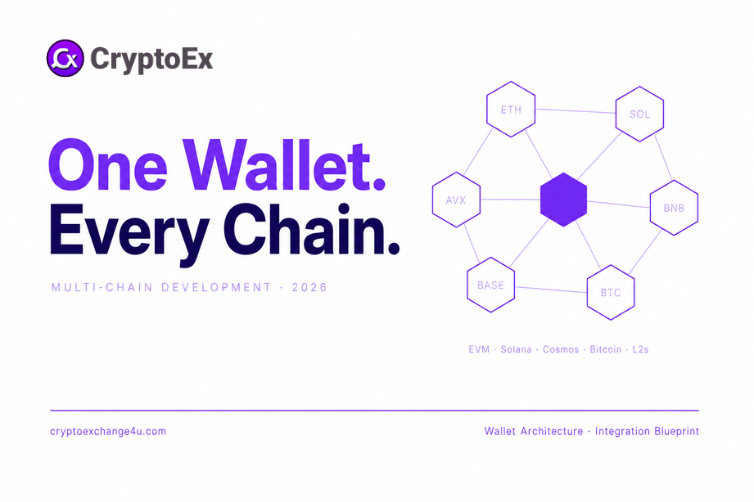
The blockchain ecosystem of 2026 runs across dozens of interconnected networks simultaneously — and the gap between what users expect and what single-chain wallets deliver has never been wider. Multi-chain wallet development has become the non-negotiable foundation for any serious Web3 product: whether you are building a centralised exchange, a DeFi protocol, an NFT marketplace, or a crypto payment platform. Users no longer accept the daily friction of juggling five separate wallets for five different chains. They want one intelligent, secure, cross-chain wallet that manages everything from Ethereum and Solana to Cosmos, Avalanche, and Base — under a single recoverable seed phrase. This guide covers the complete integration blueprint: architecture layers, supported networks, security models, DeFi connectivity, and exactly what it takes to build a wallet that earns long-term user loyalty in 2026.
What You Will Learn in This Blueprint:
- Why 2026 is the defining inflection point for multi-chain wallet infrastructure
- The layered technical architecture behind enterprise-grade cross-chain wallets
- Core blockchain networks and protocols every serious wallet must support
- Security models — MPC, TSS, account abstraction, and social recovery
- Integration pathways across DeFi, NFT marketplaces, and crypto exchanges
- How CryptoExchange4U approaches multi-chain wallet builds for production
What Is a Multi-Chain Wallet — And Why Does It Define Web3 UX in 2026?
A multi-chain wallet is a non-custodial or semi-custodial digital wallet application that enables a user to store, send, receive, and interact with assets across multiple blockchain networks from a single, unified interface. Unlike single-chain wallets — which are network-specific by design — a multi-chain wallet derives separate cryptographic key pairs for each supported blockchain from a single master seed, following BIP-32, BIP-39, and BIP-44 hierarchical deterministic standards.
The significance of this architecture grows with every new network launch. Ethereum’s Layer 2 ecosystem alone now includes Arbitrum, Optimism, Base, zkSync Era, Polygon zkEVM, Linea, and Scroll — each a fully distinct network with its own RPC endpoint, gas token, and bridge mechanism. Add Solana, BNB Chain, Avalanche, Cosmos IBC chains, TON, and Aptos, and the average active DeFi user in 2026 operates across six or more networks simultaneously. A wallet that serves only one of those chains is no longer a competitive product — it is a friction point that drives users elsewhere.
For businesses building Web3 products, the wallet layer is increasingly where user loyalty is either captured or permanently lost. A seamless multi-chain experience reduces drop-off at every funnel stage, increases on-platform transaction frequency, and positions your product as the centralised hub for a user’s entire on-chain activity — regardless of which network that activity happens on.
2026 Multi-Chain Wallet Market: What the Data Shows
- Over 420 million active non-custodial wallet addresses active across all chains (Dune Analytics, Q1 2026)
- The average DeFi power user interacts with 6.4 distinct blockchains per month
- Cross-chain transaction volume grew 317% year-over-year in 2025 (DeFi Llama)
- Account abstraction (ERC-4337) now accounts for 23% of all new Ethereum wallet deployments in 2026
- Mobile-first crypto wallet users surpassed 850 million globally by end of 2025 (Statista)
The Complete Multi-Chain Wallet Development Blueprint for 2026
Successful multi-chain wallet development is far more than connecting to multiple RPC endpoints. It requires a carefully engineered stack that handles key management, transaction signing, chain-specific encoding, cross-chain bridging, gas abstraction, and user experience — simultaneously and securely. Here is the layered architecture blueprint that production-grade wallets follow in 2026.
Layer 1 — Hierarchical Deterministic (HD) Key Architecture
The foundation of every multi-chain wallet is the HD key derivation tree. Following BIP-32 and BIP-44 standards, a single 12-word or 24-word mnemonic phrase generates a master private key from which all network-specific key pairs are deterministically derived. Each blockchain receives its own coin-type derivation path:
- Ethereum and all EVM-compatible chains:
m/44'/60'/0'/0/n - Bitcoin (Legacy / SegWit / Taproot):
m/44'/0'·m/84'/0'·m/86'/0' - Solana:
m/44'/501'/0'/0' - Cosmos SDK chains:
m/44'/118'/0'/0/n - TON (The Open Network): dedicated derivation per wallet contract version
This architecture means users hold one recovery phrase while the wallet silently manages entirely separate cryptographic identities on each blockchain. It eliminates seed phrase proliferation — historically one of the biggest sources of user confusion and security failure in crypto — and delivers a single-interface experience that feels as intuitive as a banking app.
Layer 2 — Chain Abstraction and Unified Transaction Interface
Above the key layer sits the chain abstraction layer — the middleware that translates user intent (“send 50 USDC to this address”) into chain-specific transaction formats. This layer must handle EVM transaction RLP encoding, Solana’s instruction-based model, Cosmos Amino/Protobuf signing, Bitcoin UTXO construction, and Move-based chain transactions — all exposed through a unified developer API that the front-end calls without any chain-specific logic bleeding through.
In 2026, chain abstraction is increasingly powered by modular smart account standards including ERC-7579 and cross-chain messaging protocols like LayerZero V2 and Hyperlane. These enable wallets to execute bridging, swapping, and multi-chain contract interactions as single atomic user experiences — rather than the multi-step manual processes that characterised early cross-chain UX.
Layer 3 — Account Abstraction (Smart Wallet) Support
ERC-4337 account abstraction has moved from experimental to production mainstream in 2026. Smart wallets built on this standard unlock capabilities that traditional EOA wallets cannot deliver: gas sponsorship through paymaster contracts (new users transact without needing native tokens first), transaction batching, social recovery without seed phrases, session keys for game and DeFi integrations, and programmable spending limits and whitelists.
A production wallet architecture today integrates both EOA and smart wallet flows — serving power users who want raw key control and mainstream users who prefer a seedless, recoverable, app-like experience.
Layer 4 — Cross-Chain Bridge and Swap Aggregation
In-wallet cross-chain functionality is now a standard user expectation, not a premium feature. Users want to bridge USDT from Ethereum to Solana, or swap BNB to AVAX, without leaving the wallet interface. This requires integration with bridge aggregation layers — LI.FI, Socket, Router Protocol, or Squid — that route cross-chain swaps through the optimal path across bridges including Stargate, Across, Hop, and deBridge. The wallet presents a single price-and-time quote; the aggregator handles routing complexity in the background.
Need a wallet architecture review before you build?
Our blockchain consulting service maps your exact integration requirements and recommends the right wallet stack for your specific market — no commitment required.
Blockchain Networks Every Enterprise Wallet Must Cover in 2026
Network support is not a feature list — it is a market positioning decision. Each blockchain you add unlocks a specific user segment, liquidity pool, or institutional market. The following tier structure reflects the coverage decisions that enterprise multi-chain wallets are making in 2026.
Tier 1 — Must-Have Networks (Universal User Base)
- Ethereum Mainnet — DeFi blue chips, institutional stablecoins, ERC-20 token standard
- Bitcoin (BTC) — Store of value, WBTC/rBTC liquidity, Ordinals and BRC-20 ecosystem
- BNB Smart Chain — High-volume retail trading, PancakeSwap, BEP-20 tokens
- Solana — High-throughput DeFi, SPL tokens, USDC and PYUSD payment flows
- Polygon PoS and zkEVM — Scalable Ethereum, consumer dApps, gaming and loyalty programmes
Tier 2 — High-Growth Networks (Strategic Market Reach)
- Arbitrum One and Nova — Ethereum L2 DeFi, GMX, Uniswap V4 deployment
- Base — Coinbase user onboarding channel, USDC-native, consumer crypto
- TON (The Open Network) — Telegram-embedded payments with direct access to 900M+ users
- Avalanche — Institutional DeFi, subnet architecture, GameFi
- Cosmos Hub and IBC Chains — Interchain assets, ATOM, OSMO, dYdX V4
Tier 3 — Specialist Networks (Vertical-Specific Markets)
- Aptos / Sui — Move-based DeFi, next-generation transaction throughput
- Tron — Dominant for high-volume USDT transfers in emerging markets
- zkSync Era — ZK-native DeFi with native account abstraction
- Hedera — Enterprise tokenisation, carbon credits, regulated asset infrastructure
Key Features Every Multi-Chain Wallet Development Project Needs
Supporting multiple chains is the prerequisite. What differentiates market-leading wallets in 2026 is the depth and quality of the features built on top of that multi-chain foundation. These are not optional enhancements — they are baseline expectations that sophisticated users and enterprise clients evaluate before choosing a wallet platform.
Unified Cross-Chain Portfolio Dashboard
Users demand a real-time aggregate view of their entire cross-chain holdings in a single screen: total net worth in USD or local fiat, asset breakdown by chain and token, historical performance charting, and pending transaction status across every supported network. This requires integration with multi-chain data indexers — Moralis, Alchemy NFT API, Covalent, The Graph — that query on-chain state reliably without hitting RPC rate limits during peak traffic.
In-Wallet DEX and Cross-Chain Swap Interface
Embedded swap functionality — powered by DEX aggregators like 1inch, 0x Protocol, or Jupiter on Solana — allows users to trade any token for any other token without leaving the wallet. Cross-chain swaps route through bridge aggregators automatically. Keeping swap flows inside your product ecosystem rather than redirecting to external DEX interfaces dramatically increases average session time and creates a direct revenue stream through embedded swap fees.
NFT Management and Marketplace Connectivity
With NFT activity distributed across Ethereum, Solana, and Polygon simultaneously, wallet-native NFT management is no longer optional. Users expect to view, send, receive, and list NFTs across all chains — with full metadata display, collection grouping, floor price data, and one-click access to connected NFT marketplaces. For businesses building NFT marketplace development platforms, deep wallet integration transforms the creator-to-collector experience from a multi-app journey into a single, frictionless flow.
DeFi Protocol Integration
Direct integration with lending protocols (Aave V3, Compound V3), DEX liquidity positions (Uniswap V4, Curve), yield platforms (Yearn, Pendle), and staking dashboards allows users to participate in DeFi from within the wallet UI itself. Combined with DeFi token development and launch services, this creates an end-to-end pathway from token creation through to live DeFi participation — all accessible without users ever leaving the wallet environment.
WalletConnect v2 (Reown) and In-Wallet dApp Browser
WalletConnect V2, now operating under the Reown brand, is the universal connectivity standard that links wallets to decentralised applications. Any wallet without it is effectively invisible to the majority of Web3 dApps. A built-in dApp browser takes this further — users discover and interact with vetted DeFi, NFT, and gaming applications directly within the wallet, while all transaction signing happens through the same secure WalletConnect session infrastructure.
Hardware Wallet Integration
For high-value users — institutional clients, large holders, and privacy-focused power users — integration with Ledger (via Ledger Live SDK) and Trezor provides an additional physical signing layer. The wallet software handles the interface and transaction construction; the hardware device holds the private key and authorises the signature. This “software UX, hardware security” model represents the highest-trust configuration available in self-custody wallets.
Gas Abstraction via ERC-4337 Paymasters
Gas management remains the single worst experience in consumer crypto. Via ERC-4337 paymaster contracts, wallets in 2026 can sponsor gas fees entirely for new users (eliminating the “I need ETH before I can do anything” onboarding failure), allow gas payment in USDC or any ERC-20, and batch multiple DeFi actions into a single gas-efficient transaction. Paymaster support is now a competitive requirement for any wallet targeting mainstream users or regulated enterprise clients.
Biometric Authentication and Secure Enclave Key Storage
Mobile wallet security leverages device-level cryptographic hardware: Face ID or fingerprint authentication gates every transaction signature; private keys (or MPC key shares) are stored within the iOS Secure Enclave or Android StrongBox hardware security module — never in application memory or standard device storage. These controls raise the bar substantially for device-theft attacks while reducing legitimate-user friction to a single biometric gesture.
Not sure which features your specific use case requires?
Book a free initial blockchain consulting service session with our team. We scope your feature requirements, recommend the right architecture, and give you a clear development roadmap before any commitment is made.
Security Architecture for Enterprise Multi-Chain Wallets
Security in multi-chain wallets is intrinsically harder than in single-chain wallets because the attack surface multiplies with every additional network. A vulnerability in one chain’s transaction encoder, RPC provider, or bridge integration can potentially be exploited to compromise assets across all supported networks. The security architecture must address this at every layer — not just at the key management level.
Multi-Party Computation (MPC) and Threshold Signature Schemes (TSS)
MPC wallets distribute private key material across multiple parties — user device, cloud backup server, optional hardware factor — such that no single party ever holds a complete private key. Threshold Signature Scheme (TSS) protocols allow transaction signing with M-of-N key shares without ever reconstructing the full key in memory. This eliminates the single point of failure inherent in seed-phrase EOA wallets while maintaining non-custodial key ownership at the cryptographic level.
For enterprise deployments — exchanges building custodial wallets, fintech apps requiring account recovery, or institutions managing treasury assets — MPC is now the architecture of choice. Our blockchain consulting service team can guide you through MPC vendor selection (Fireblocks, ZenGo, Liminal, Fordefi) and implementation trade-offs based on your specific custody model and regulatory environment.
Smart Contract Security Auditing and Formal Verification
Every smart wallet component — account abstraction contracts, paymaster logic, cross-chain bridge integrations, staking modules — must undergo rigorous third-party security auditing before mainnet deployment. Leading audit firms for wallet-adjacent smart contracts include OpenZeppelin, Trail of Bits, Zellic, and Certora. Formal verification (using tools like the Certora Prover or Halmos) mathematically proves that smart contract logic behaves exactly as specified under all possible inputs — the gold standard for high-value financial infrastructure.
Pre-Transaction Simulation and Signing Preview
Before a user approves any transaction, the wallet should simulate it against the current blockchain state — showing exact token balance changes, any ERC-20 approval grants, and flagging unexpected outcomes such as approvals granted to unverified contracts or rug-pull signatures. Pre-signing simulation services (Blowfish API, Pocket Universe, Stelo) flag wallet-drainer attacks and malicious phishing signatures before the user clicks confirm. Implementing this single feature prevents the majority of on-chain theft vectors that cost the industry billions annually.
Integrating Multi-Chain Wallets With Exchanges, DeFi, and Payment Infrastructure
A multi-chain wallet operating in isolation generates limited business value. Its real commercial power comes from integration with adjacent blockchain infrastructure — centralised exchanges, DEXs, payment gateways, and DeFi protocols — creating a closed-loop ecosystem where users have no reason to leave your platform for any on-chain activity.
Integration With Centralised Exchange Platforms
For operators running white-label cryptocurrency exchanges, the wallet layer manages non-custodial user balances while the exchange engine handles order matching and trade settlement. Deposits route from the user’s self-custody wallet to the exchange’s hot wallet infrastructure; withdrawals flow back to any supported external address on any supported chain. This hybrid custodial/non-custodial architecture is the dominant model for exchange launches in 2026 — offering regulatory flexibility alongside the user trust that self-custody enables.
Integration With Decentralised Exchange Platforms
On-chain trading via decentralised exchange platforms integrates directly through WalletConnect sessions or embedded DEX widget SDKs. The wallet handles authentication, key management, and transaction signing; the DEX handles price discovery, liquidity routing, and on-chain settlement. Cross-chain DEX integration — through aggregators that simultaneously route across Uniswap, Curve, Jupiter, and Trader Joe — gives users best-execution pricing across all supported networks from a single wallet interface.
Integration With Cryptocurrency Payment Infrastructure
For merchants and e-commerce operators, the multi-chain wallet becomes the payment interface. Integration with cryptocurrency payment gateway solutions enables one-click checkout in any supported token across any supported network — with automatic fiat conversion for merchants who prefer to receive settled local currency. Multi-chain support means customers pay in USDC on Base, ETH on Arbitrum, or BNB on BSC; the gateway handles the conversion and merchant settlement invisibly.
Integration With NFT Ecosystems and Marketplaces
Wallet-to-marketplace connectivity allows users to list, bid, purchase, and transfer NFTs directly from the wallet’s asset view. For businesses building cross-chain NFT marketplaces, deep wallet integration is not a nice-to-have — it is the core user journey. Listing an NFT should require one action from the wallet’s asset screen, not five steps across two browser tabs and an external marketplace sign-in.
How CryptoExchange4U Delivers Multi-Chain Wallet Development
CryptoExchange4U’s blockchain development team has architected and delivered wallet infrastructure for exchange operators, DeFi protocols, and payment platforms across multiple blockchain ecosystems. Our approach to multi-chain wallet development follows a structured framework designed to balance technical depth with the speed-to-market that competitive blockchain businesses require.
Discovery and Architecture Workshop
Every engagement begins with a structured blockchain consulting service workshop — a technical discovery session where we map your target user base, required network coverage, custodial model preference (non-custodial EOA, MPC hybrid, or institutional custodial), regulatory constraints, and integration dependencies with existing exchange or payment infrastructure. This workshop produces a complete technical specification and phased project roadmap before any development work begins.
Modular, Chain-Adapter Architecture
We build wallet infrastructure as modular, independently upgradeable components: the key management module, chain adapter layer, cross-chain swap engine, UI layer, and integration middleware are separate, versioned codebases — not a monolithic system that becomes impossible to extend as the blockchain landscape evolves. When a new network needs to be added post-launch — and new chains are launching constantly — the chain adapter model means integration takes days rather than months.
For businesses that require both wallet infrastructure and exchange functionality, our delivery team coordinates both products within a unified technical architecture. Whether you are launching a new white-label cryptocurrency exchange alongside a self-custody wallet, or adding DeFi protocol interaction to an existing exchange product, the same development team manages the full stack — eliminating the risk of integration failures between separately developed components. We also deliver custom smart contract development for wallet-adjacent functionality: staking contracts, vesting schedules, governance modules, and paymaster infrastructure.
Security Review and Pre-Mainnet Audit Coordination
Before any production deployment, we coordinate third-party security audits for all smart contract components, review RPC provider redundancy across every supported chain (eliminating single-points-of-failure in node infrastructure), and implement pre-transaction simulation tooling. All audit findings are fully remediated with documentation before the production codebase is handed to the client.
Post-Launch Support and Ongoing Network Expansion
Blockchains upgrade, fork, and occasionally deprecate features — sometimes with short notice. Our ongoing support retainer ensures your wallet tracks mainnet changes (EIP activations, RPC endpoint deprecations, bridge updates) without disruption to live users. Chain expansion requests are handled by the team that originally built the wallet — preserving architectural consistency and eliminating knowledge-transfer risk from new external developers.
Real Business Use Cases: Who Is Building Multi-Chain Wallets in 2026?
Crypto Exchange Operators
Exchange operators using white-label exchange platforms integrate multi-chain wallets to deliver a single-app experience: users trade on the exchange, self-custody assets off-exchange, and interact with DeFi protocols — without ever switching applications. This depth of integration converts casual traders into long-term platform loyalists who have no reason to take their assets elsewhere.
DeFi Protocol Teams
DeFi protocols operating across multiple chains require a wallet interface that abstracts cross-chain complexity for users who may not understand the mechanics beneath the experience. Teams pursuing DeFi token launches benefit specifically from wallet-native token management — staking, governance voting, liquidity provision, and reward compounding — available from the moment the token goes live on-chain.
Regulated Fintech and Neobank Products
Regulated fintech companies adding crypto functionality to existing financial applications require wallets with compliance-first architecture from the ground up: KYC-gated access tiers, real-time transaction monitoring, AML screening on all outbound transfers, and complete audit logs suitable for regulatory reporting. Multi-chain support with fiat on/off ramp integration creates a comprehensive digital asset banking experience within a fully compliant product wrapper.
Web3 Gaming and Metaverse Platforms
Web3 games routinely operate across Immutable X, Ronin, Polygon, and Arbitrum Nova simultaneously. Players need wallets that handle in-game asset ownership (NFTs), cross-game item portability, play-to-earn reward collection and reinvestment, and fiat cash-out — all within a mobile-first interface optimised for gamers, not crypto-native users. The wallet that wins this audience is the one that makes complex on-chain mechanics feel as simple as an in-app purchase.
Frequently Asked Questions About Multi-Chain Wallets
Q: How long does it take to develop a production-ready multi-chain wallet?
A production-ready multi-chain wallet typically requires 16 to 26 weeks of development, depending on the number of supported chains, the custody model chosen, and the overall feature scope. A wallet covering five EVM-compatible chains with standard functionality (send, receive, swap, NFT view, WalletConnect) can realistically be delivered in approximately 16 weeks. Adding non-EVM chains like Solana, Bitcoin, and Cosmos alongside account abstraction support and MPC key management extends the realistic timeline to 22–26 weeks. Starting with a structured blockchain consulting service session accelerates the architecture specification phase significantly and prevents the costly mid-development pivots that delay most wallet projects.
Q: What is the difference between custodial and non-custodial multi-chain wallets?
In a non-custodial wallet, the user holds their own private keys — the development team and platform operator have zero access to funds. In a custodial wallet, the platform holds keys on behalf of users, enabling account recovery but introducing centralised custody risk and typically triggering regulated financial services obligations. Most enterprise wallet deployments in 2026 opt for an MPC-based hybrid model: users experience custodial-level convenience (no seed phrase to manage, account recovery available through social or biometric flows) while the underlying architecture remains cryptographically non-custodial — no single party, including the development team, can unilaterally access user funds.
Q: Which blockchains should a 2026 wallet launch with?
A viable 2026 launch should cover at minimum: Ethereum mainnet, BNB Smart Chain, Polygon, Solana, and Arbitrum — this combination covers the majority of global DeFi activity, NFT volume, and on-chain payment flows. Bitcoin support adds meaningful development complexity (UTXO model versus account-based EVM) but is essential for any wallet targeting store-of-value users or institutional clients. Base and TON are high-value additions that open access to the Coinbase user base and Telegram’s 900M+ monthly active users respectively. The modular chain adapter architecture we recommend allows new networks to be added post-launch without any architectural refactoring — reducing the pressure to get every chain right at initial deployment.
Q: How does multi-chain wallet development differ from building a single-chain wallet?
Multi-chain wallet development introduces compounding complexity at every architectural layer compared to a single-chain wallet. Key derivation must follow chain-specific BIP-44 coin-type paths. Transaction encoding differs fundamentally between EVM, UTXO, Solana’s account model, and Cosmos’s Protobuf signing. RPC infrastructure must be maintained across all supported networks with active failover redundancy. Gas estimation algorithms, fee market dynamics, and confirmation time expectations vary significantly by chain. The portfolio UI must aggregate on-chain data from multiple independent indexers and present it coherently in a unified interface. Each additional chain is not incremental complexity — it multiplies the testing matrix, the security review scope, and the ongoing maintenance surface area in ways that compound over time.
Q: Can a multi-chain wallet be integrated with an existing crypto exchange?
Yes — and this is one of the most common and commercially powerful integration patterns in 2026. The wallet integrates with an exchange platform through a well-defined API layer: the exchange engine manages order books, trade matching, and custodial balances; the wallet manages non-custodial self-custody storage and direct on-chain interactions. Users move funds between exchange custody and self-custody seamlessly through the same interface. This architecture is supported natively within our white-label cryptocurrency exchange platform, with pre-built wallet API integration points that substantially reduce custom integration time and risk for operators building both products simultaneously.
Conclusion: The Multi-Chain Wallet Is the Product in 2026
The blockchain landscape of 2026 is not converging toward a single dominant chain. It is permanently, structurally multi-chain — and every market signal points toward that fragmentation deepening, not narrowing, over the next several years. Users, liquidity, and developer activity are distributed across dozens of networks simultaneously, and any wallet product that serves only one of those networks will feel increasingly like a specialised tool in a world that demands a universal one.
The businesses that capture the wallet layer in 2026 are those investing now in a robust, secure, and genuinely cross-chain architecture — one that manages the complexity of the multi-chain ecosystem invisibly, so that users experience only seamless simplicity on the surface. The blueprint is clear: HD key architecture, chain abstraction, account abstraction, MPC security, cross-chain swap aggregation, and deep integration across DeFi, NFT, and exchange ecosystems.
CryptoExchange4U is ready to build it with you. Whether you are launching a new wallet product from scratch, integrating wallet functionality into an existing exchange platform, or adding multi-chain reach to a DeFi protocol, our team brings the architecture expertise, security rigour, and delivery track record to move you from technical specification to production-ready code — efficiently and without surprises. Start by visiting our contact page or submitting a detailed brief through our project enquiry page — our team responds within one business day with a structured assessment of your requirements.
Build Your Multi-Chain Wallet With CryptoExchange4U
Start With a Free Blockchain Consulting Session
Our team reviews your wallet requirements, recommends the right architecture and custody model, and delivers a clear project roadmap — all at no cost and no obligation. Every successful multi-chain wallet starts here.
Book a Free Consulting Session →
Explore More from CryptoExchange4U:
White-Label Cryptocurrency Exchange Software
















0 Comments