
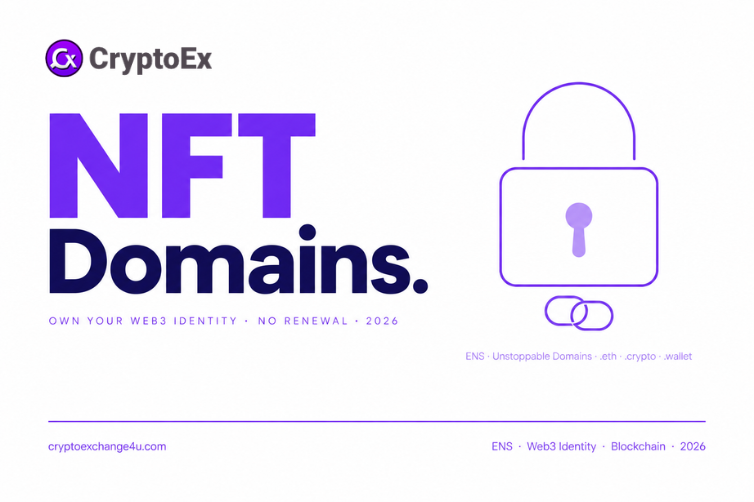
Every time someone sends crypto, they’re copying and pasting a string of characters that looks something like this: 0x4Ef2B7a3c1D9… It’s one of the most persistent friction points in Web3 — and NFT domains exist to solve it. But what started as a convenience feature has evolved into something much bigger: a fundamental building block of decentralized identity. In 2026, entrepreneurs are building serious businesses around this technology, and the window for early movers is still open.
Here’s what you need to understand about NFT domains — from what they actually are to the opportunity they represent for builders.
What Is an NFT Domain?
An NFT domain is a blockchain-based domain name that is owned as a non-fungible token. Unlike a traditional domain — which you license from a registrar and can have revoked — an NFT domain is minted on-chain and stored in your wallet. You own it outright, indefinitely, with no renewal fees and no central authority that can take it away.
The practical use cases go well beyond branding. An NFT domain functions as a human-readable wallet address, so instead of sharing a 42-character string, someone can receive payments at a name like alice.eth or mybrand.crypto. It also serves as a portable Web3 identity — a single handle that connects a user’s wallet, decentralized website, dApp logins, and on-chain profile across the entire ecosystem.
Leading platforms in this space include Ethereum Name Service (ENS), which holds around 85% of the Ethereum naming market with over 1.6 million registered names, and Unstoppable Domains, which has expanded across chains with extensions like .crypto, .nft, .wallet, and .dao. Each blockchain ecosystem is developing its own naming layer — Solana has .sol, BNB Chain has its own DNS infrastructure, and the space is growing rapidly across chains.
Why NFT Domains Are Getting Serious Attention in 2026
The broader NFT market provides important context. The global NFT market is projected to reach approximately $86 billion in 2026, up from $60 billion in 2025 — and blockchain-based identity infrastructure is one of the most durably useful segments within it. Unlike speculative digital art, NFT domains have clear, everyday utility that grows with Web3 adoption.
Several forces are accelerating traction right now. The rise of stablecoins and on-chain payments means more businesses and individuals are actively transacting in crypto — creating direct demand for readable wallet names. Web3 adoption is up 40% year-over-year, and with over 3.3 million new blockchain domain names registered in 2025 alone, the registration volume signals real user intent rather than speculation. The decentralized identity market overall is expected to grow from roughly $6.9 billion today to over $100 billion by 2035 — and NFT domains sit squarely at the center of that shift.
The Business Models That Work
Building an NFT domain platform isn’t just technically interesting — it’s commercially viable through multiple revenue channels.
Domain registration fees are the most straightforward. Users pay a one-time fee to mint their domain. Unlike traditional DNS registrars, the no-renewal model is actually a selling point that drives initial conversion — but the volume at scale makes it compelling.
TLD ownership and royalties represent a higher-leverage model. Some platforms allow entrepreneurs to own an entire top-level domain extension and collect a royalty on every second-level domain registered under it. This turns domain infrastructure into a recurring revenue stream.
Secondary marketplace fees — domains are tradeable NFTs, and premium names change hands for significant sums. Platforms that facilitate this secondary market earn a percentage of every transaction.
Premium naming and brand protection services — businesses pay for enterprise tiers that include brand protection, monitoring for squatters, and portfolio management tools across multiple extensions.
The Real Market Scope
NFT domains aren’t a niche for crypto enthusiasts only. The use cases extend to any business receiving crypto payments, any creator building a Web3 presence, any brand protecting its identity in decentralized ecosystems, and any dApp looking to simplify user onboarding. That’s a broad and growing addressable market — one that scales directly with overall Web3 adoption.
Key Technical Challenges to Solve
Building an NFT domain platform well is not trivial. The core challenges every development team has to navigate include smart contract architecture for minting, transferring, and resolving domain records; resolver infrastructure that maps domain names to wallet addresses across supported chains; cross-chain compatibility, since users expect their domain to work across Ethereum, Solana, BNB Chain, and Polygon; decentralized storage for website hosting and profile data; and namespace collision management to prevent the same domain from existing across competing systems.
There’s also the ICANN question — traditional DNS and blockchain naming systems don’t natively interoperate, and platforms that want browser-accessible decentralized websites must solve resolution compatibility. This is an active technical challenge that the best-built platforms address from the architecture stage, not as an afterthought.
Getting this right from the start requires experienced Web3 developers who understand both smart contract development and DNS/naming system architecture. At Gegosoft, we build blockchain identity and domain infrastructure that handles these challenges properly — from smart contract design through cross-chain resolver integration and marketplace functionality. If you’re exploring an NFT domain platform or Web3 naming service, start a consultation with our team and let’s scope out what it takes to build it right.






0 Comments