
Social media has always had a monetization problem — just not for the platforms themselves. For over a decade, centralized giants like Facebook, YouTube, and Twitter captured the overwhelming majority of value generated by creators and communities, while the people actually producing content received a fraction of what they earned. SocialFi platforms are built to fix that fundamental imbalance — and in 2026, this is no longer an experiment. It’s a fast-maturing $17.11 billion market attracting serious capital and serious builders.
If you’re an entrepreneur, investor, or developer looking at the next wave of Web3 opportunity, here’s what you need to understand about SocialFi platform development.
What Is a SocialFi Platform?
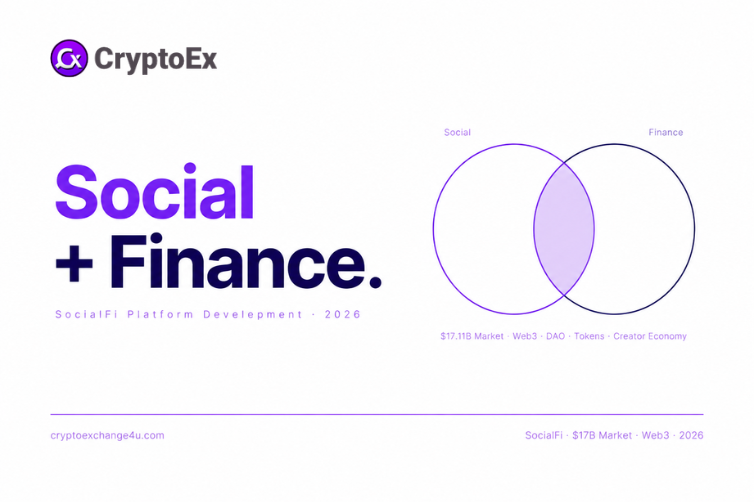
SocialFi — short for Social Finance — represents the fusion of social media and decentralized finance. At its core, a SocialFi platform is a blockchain-based social network where users own their content, earn rewards for engagement, and participate directly in the platform’s economic model through tokens, NFTs, and on-chain governance.
Unlike traditional social media where platforms extract value from user attention and sell it to advertisers, SocialFi distributes that value back to creators, contributors, and community members. Content creators earn directly through social tokens, tipping mechanisms, NFT drops, and subscription-based communities — without algorithms deciding their worth or platforms taking 30-50% cuts.
The underlying infrastructure runs on blockchain technology. User data lives on decentralized storage systems, interactions are recorded on-chain, and economic rules are governed by smart contracts rather than corporate policy teams that change terms without notice.
Why SocialFi Is Capturing Serious Attention in 2026
The timing isn’t coincidental. Several converging forces brought SocialFi into mainstream conversation this year, and the numbers validate the momentum.
The global SocialFi market reached $17.11 billion in 2026, up from $14.78 billion in 2025 — representing 15.8% year-over-year growth. Industry analysts project the sector will surpass $63.6 billion by 2035, reflecting a 15.71% compound annual growth rate. This isn’t speculative hype; it’s supported by a global base of 400+ million crypto users and a creator economy exceeding 50 million creators actively seeking alternatives to ad-driven monetization models.
Creator frustration reached critical mass in 2025. Mid-tier creators on traditional platforms saw ad earnings drop 40-60% as algorithms increasingly favored mega-influencers and short-form viral content. Over one million pieces of content were removed from major platforms for vague policy violations, often with no appeal process. Creators are actively searching for alternatives where they control audience relationships and revenue streams.
The infrastructure finally matured to support mainstream adoption. Layer-2 scaling solutions reduced transaction costs by 95%, making micro-transactions and token rewards economically viable for everyday users — something impractical just two years ago when gas fees exceeded the value being transferred.
The Business Models Driving SocialFi Success
SocialFi platforms aren’t locked into single revenue models, which makes the category particularly attractive for entrepreneurs. The most successful implementations combine multiple revenue streams:
Transaction fee revenue forms the foundation. Platforms earn percentages on every on-chain transaction: token trades, NFT sales, tipping, and subscriptions. As activity scales, this revenue compounds naturally without requiring platform intervention.
Social token issuance and management creates secondary revenue. Platforms issue native tokens powering their ecosystems while creators launch personal tokens. The platform earns through token launch fees, trading commissions, and secondary market activity. Over 60% of active SocialFi platforms already integrate DAO structures for governance, with token holders voting on platform decisions.
Premium memberships and token-gated communities convert engaged audiences into direct revenue. Users pay in crypto to access exclusive content, communities, or creator tiers. Unlike subscription models on Web2 platforms where creators receive 50-70% after platform cuts, SocialFi smart contracts can distribute 85-95% directly to creators while maintaining platform profitability through volume.
NFT marketplace integration enables creators to mint and sell digital collectibles representing exclusive content, experiences, or community access. Platform transaction fees on these sales create additional revenue while providing creators with new monetization mechanisms impossible on traditional platforms.
Market Scope Beyond Influencer Platforms
SocialFi extends far beyond influencer platforms, though that remains the most visible category. The model encompasses gaming communities where players earn tokens for achievements and contributions, sports fan ecosystems enabling direct interaction with teams and athletes, music and entertainment platforms giving artists alternatives to streaming services that pay fractions of pennies, and professional networks where expertise and connections carry tokenized value.
More than half of active SocialFi platforms connect directly with DeFi protocols, letting users earn yield on their social tokens alongside engagement rewards. This creates compounding incentives where social activity generates tokens that can be staked for additional returns — transforming casual participation into meaningful economic activity.
North America leads SocialFi value creation with 35-40% of market share, while Asia-Pacific represents the fastest-growing region with 25-30%+ user share driven by mobile-first and gaming-centric markets. Europe maintains 20-25% share with regulatory progress under MiCA frameworks, and the Middle East & Africa, though smaller at 5-10%, shows high adoption potential in crypto-active populations.
Technical Architecture for SocialFi Platforms
Building successful SocialFi platforms requires sophisticated technical architecture integrating multiple blockchain components. Smart contract development handles token issuance, reward distribution, and governance mechanisms. These contracts must be gas-optimized to keep transaction costs minimal while maintaining security against common vulnerabilities.
Decentralized storage solutions like IPFS or Arweave host user-generated content, ensuring censorship resistance and permanent availability without centralized server dependencies. This architecture means platforms can’t arbitrarily delete content or suspend accounts — a fundamental difference from Web2 social media.
Wallet integration and onboarding systems must accommodate non-crypto users. The most successful platforms implement progressive onboarding where users can participate without understanding blockchain mechanics, gradually introducing Web3 concepts as engagement deepens. Account abstraction and gasless transactions remove friction that historically prevented mainstream adoption.
Tokenomics design determines platform sustainability. Most failed SocialFi experiments collapsed because reward emission rates exceeded value creation, inflating token supplies and destroying economic incentives. Professional blockchain development services model token economics across multiple scenarios, stress-testing incentive mechanisms before deployment.
Common Development Mistakes to Avoid
The most frequent error early-stage SocialFi projects make is overinvesting in UI while underinvesting in tokenomics. Beautiful interfaces can’t save platforms with broken incentive models. Users quickly identify when reward systems don’t align with value creation, leading to mercenary behavior where participants extract maximum value with minimum contribution.
Governance mechanisms require careful design. Platforms giving too much control to early adopters create plutocracies where whales manipulate decisions for personal benefit. Insufficient governance leaves communities frustrated when they can’t influence platform direction. The balance requires sophisticated voting mechanisms, time-locks, and proposal thresholds preventing abuse while enabling meaningful participation.
Security audits prove non-negotiable for platforms handling user funds and token economies. The approximately $2.8 billion lost to DeFi hacks in recent years demonstrates what happens when platforms skip comprehensive security reviews. Professional smart contract audits from firms like Trail of Bits, ConsenSys Diligence, or OpenZeppelin identify vulnerabilities before deployment.
How to Start Building Your SocialFi Platform
Successful SocialFi platform development requires coordinating multiple specialized components. The essential layers include smart contract architecture for tokens and rewards, decentralized storage integration for content, wallet connectivity and user onboarding systems, tokenomics modeling ensuring long-term sustainability, governance frameworks giving communities real decision-making power, and content moderation balancing decentralization with quality control.
Development timelines typically span 4-8 months for comprehensive platforms including testing, auditing, and beta deployment. Costs range from $80,000 to $300,000 depending on feature complexity, blockchain selection, and customization requirements. These investments pale compared to potential returns as successful platforms capture network effects and token appreciation.
Blockchain selection impacts every aspect of platform performance. Ethereum provides maximum security and ecosystem integration but higher transaction costs even with Layer-2 solutions. Solana offers superior performance with 65,000 TPS and $0.00025 average fees but less established tooling. Polygon and Arbitrum balance Ethereum compatibility with reduced costs. The choice depends on target users, content types, and transaction frequency.
The Path Forward
SocialFi represents one of blockchain’s clearest paths to mainstream adoption. Unlike DeFi protocols requiring financial literacy or NFT marketplaces demanding understanding of digital scarcity, social platforms offer familiar interfaces while delivering superior economic models. The 50 million+ creators actively exploring Web3 revenue streams represent the addressable market well-built SocialFi platforms compete for.
The market is still early enough that differentiated platforms can capture meaningful share, but mature enough that infrastructure challenges are largely solved. First-mover advantages matter less than execution quality and sustainable tokenomics. The platforms that will dominate 2027-2028 are being built right now by teams who understand both social dynamics and blockchain economics.
Ready to build your SocialFi platform? Partner with experienced blockchain developers who understand social economics, smart contract security, and token design. Whether you have a complete vision or need help refining your concept, professional development teams transform ideas into platforms that capture real value in the fastest-growing category of Web3.
The SocialFi revolution is here. The question isn’t whether decentralized social platforms will reshape digital interaction — it’s whether you’ll build the infrastructure powering that transformation.


















0 Comments