
For most of the internet era, building physical infrastructure meant one thing: raising enormous amounts of capital, deploying it through a centralized company, and hoping the returns justified the cost. Telecom towers, data centers, wireless networks — all of it controlled by a handful of corporations with the resources to build at scale.
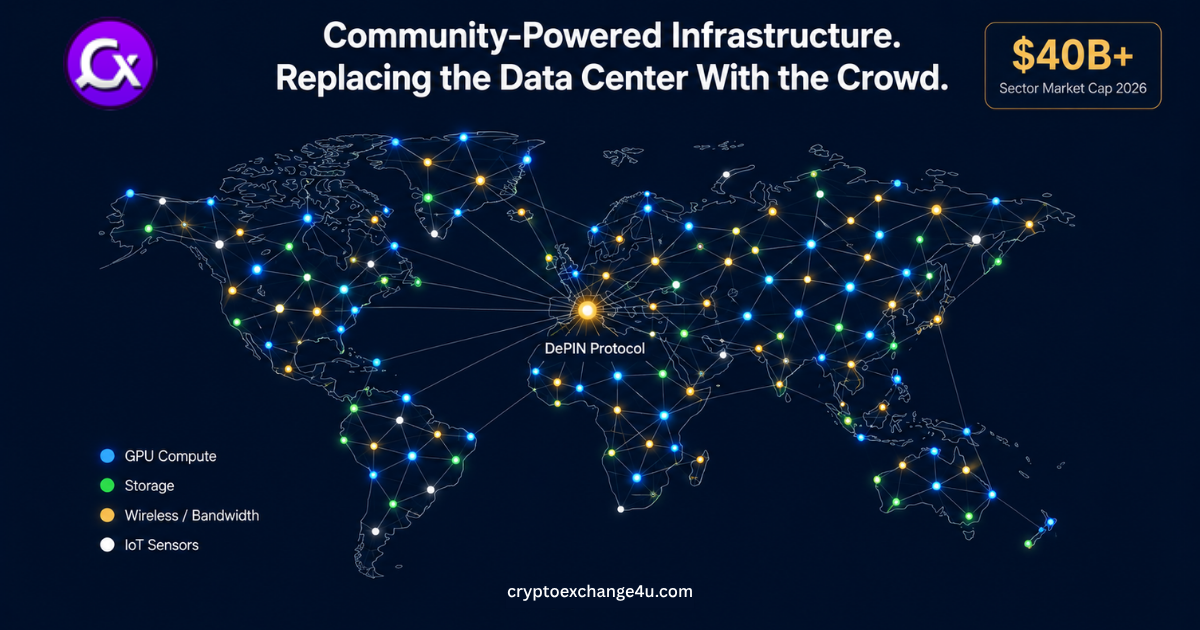
DePIN is changing that model entirely. Decentralized Physical Infrastructure Networks replace centralized ownership with community-powered participation — turning everyday hardware operators into infrastructure contributors who earn token rewards for the resources they provide. In 2026, this isn’t a whitepaper concept. It’s a sector with over 200 active projects, a combined market capitalization exceeding $40 billion, and a growth trajectory that’s attracting serious developer and investor attention.
Here’s what entrepreneurs need to understand about DePIN platform development — and why right now is one of the best windows to build in this space.
What DePIN Actually Is
DePIN stands for Decentralized Physical Infrastructure Network. The core idea is straightforward: instead of a single company owning and operating all the physical infrastructure in a network — the servers, the antennas, the storage drives, the GPUs — a DePIN protocol coordinates thousands of independent operators who contribute their own hardware in exchange for token rewards.
The result is a network that can scale faster, at lower cost, and across more geographies than any centralized provider could achieve alone. And because the infrastructure is distributed across many independent participants, it’s also more resilient — there’s no single point of failure and no single entity that can arbitrarily shut it down or raise prices.
The categories where DePIN is already operating at scale include wireless connectivity (Helium Mobile reached nearly 600,000 sign-ups by early 2026), decentralized GPU compute for AI workloads (Bittensor, Render), distributed storage (Filecoin), bandwidth sharing, IoT sensor networks, and energy distribution. The common thread across all of them is the same: real hardware, real utility, and token incentives that make participation economically rational for contributors.
Why 2026 Is a Pivotal Year for DePIN
Several forces are converging to make DePIN one of the defining Web3 themes of this year.
AI infrastructure demand is the most significant driver. Training and running AI models requires massive amounts of GPU compute and storage — resources that centralized cloud providers are struggling to supply fast enough. DePIN networks that can aggregate distributed GPU capacity at scale are filling a gap that AWS, Google Cloud, and Azure simply can’t close quickly enough through traditional capex cycles.
Web3 infrastructure itself has matured to the point where running a reliable DePIN protocol is technically feasible in ways it wasn’t two years ago. Proof-of-physical-work mechanisms — cryptographic systems that verify operators are providing real, claimed resources — have become sophisticated enough to prevent gaming and ensure network integrity at scale.
The economics are also increasingly compelling. Established DePIN networks are offering 15–25% annual returns on deployed capital for infrastructure operators, comparable to traditional infrastructure investments but accessible to participants who could never afford a share of a data center or a cell tower. That’s a fundamentally new investor class entering the space.
The Business Models Behind DePIN Platforms
DePIN platforms generate revenue and sustain their ecosystems through several interconnected mechanisms that are worth understanding before you build.
Token incentive systems are the engine of every DePIN network. Contributors earn native tokens for providing verified resources — compute, storage, bandwidth, data. The platform earns through token issuance, treasury management, and governance mechanisms. Well-designed tokenomics keep contribution rates high while avoiding inflationary spirals that erode operator returns.
Network service fees are where commercial sustainability lives. Businesses and developers who consume the network’s resources — renting compute, purchasing storage, using bandwidth — pay in tokens or fiat. As demand grows, so does fee revenue, which funds both operator rewards and protocol development.
Staking and governance participation allows token holders to lock assets and earn additional yield — currently ranging from 4–12% annually depending on the protocol — while deepening their alignment with the network’s long-term health.
Data monetization and analytics is an emerging layer, particularly for sensor networks and IoT-focused DePIN projects. Verified, on-chain data streams have commercial value to enterprises, researchers, and AI training pipelines — and platforms that aggregate and sell access to this data create a revenue stream that compounds with network growth.
The Real Market Scope
DePIN is one of the few Web3 categories with a direct, measurable real-world use case that scales with global infrastructure demand. The addressable market isn’t just crypto users — it’s every business that needs compute, storage, connectivity, or data infrastructure. That’s essentially every business.
The market capitalization of the DePIN sector crossed $19 billion in late 2025 and is projected to reach $3.5 trillion by 2028 as the model proves itself across more infrastructure categories. Businesses building DePIN platforms benefit from dramatically lower capital requirements than traditional infrastructure — contributors supply the hardware, which fundamentally changes the unit economics of building at scale.
What It Takes to Build a DePIN Platform
Building a DePIN platform is technically demanding in ways that differ meaningfully from building a typical DeFi protocol or NFT marketplace. The core layers that need to work together from day one include smart contract architecture for token issuance, contribution tracking, and reward distribution; proof-of-physical-work verification systems that cryptographically validate contributor claims; node onboarding and hardware management infrastructure; a token economy designed to sustain contributor participation without unsustainable emissions; and governance mechanisms that give network participants real decision-making power as the network matures.
The technical complexity is real — but so is the competitive advantage that comes from building it right from the start. Networks that launch with solid verification mechanisms, sustainable tokenomics, and a clear go-to-market for demand-side adoption are the ones that build lasting ecosystems rather than fading after the initial token launch.
At Gegosoft, we build Web3 infrastructure platforms — from smart contract architecture through token economy design and full-stack development — for entrepreneurs who are serious about launching networks that last. If you’re exploring a DePIN concept and want to understand what it would take to build it properly, start a consultation with our team and let’s map out the architecture together.

















0 Comments