
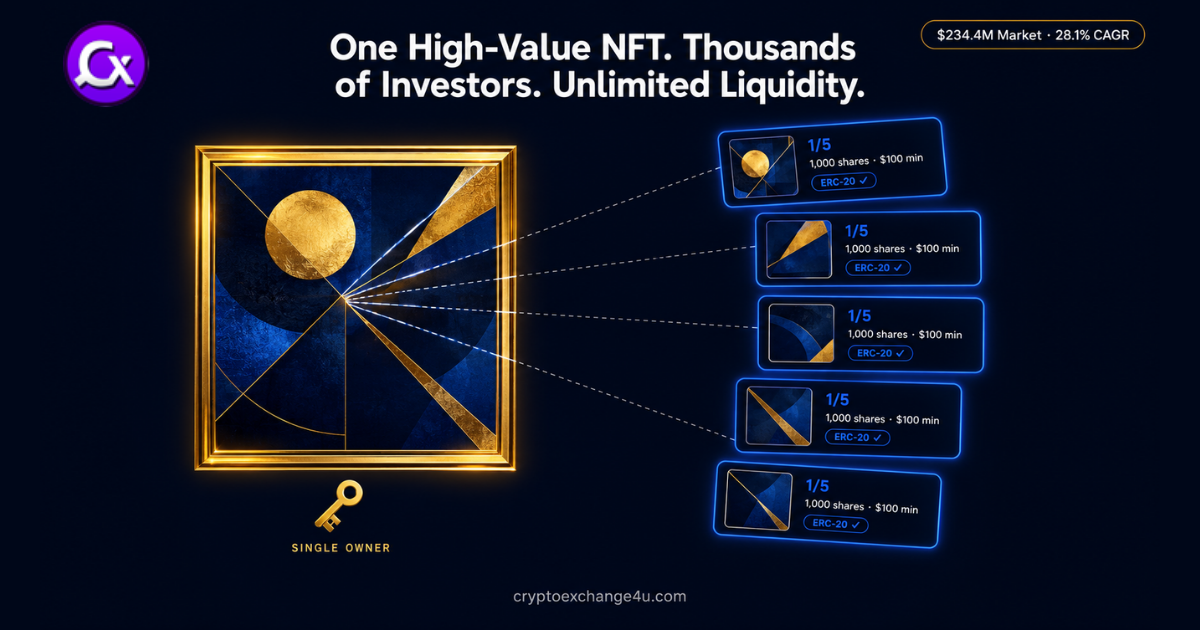
A fractional NFT marketplace is a blockchain platform that splits high-value NFTs into smaller ERC-20 tradeable shares using smart contracts — enabling multiple investors to co-own premium digital assets. The NFT fractionalization market is valued at $234.4 million in 2026, growing at 28.1% CAGR through 2034.
There’s a liquidity problem sitting at the heart of the high-value NFT market. A rare digital artwork, a prime piece of metaverse real estate, or a blue-chip collectible worth hundreds of thousands of dollars sits locked in a single wallet. One owner. No yield. No secondary activity. No pathway for the broader market to participate without raising the full purchase price.
Fractional NFTs solve that problem — and in 2026, they’re unlocking billions in previously frozen value across the digital asset ecosystem. The NFT fractionalization platform market is projected to reach $1.67 billion by 2034, while the broader NFT market hit $60.82 billion in 2026 — growing at 41.2% annually. More than 30% of institutional NFT deals now include fractional ownership structures, signaling that this model has moved well past the experimental phase.
For entrepreneurs, fractional NFT marketplace development represents one of the highest-leverage opportunities in Web3 right now: a platform category with genuine utility, multiple revenue streams, and a growing institutional tailwind. This guide covers everything you need to understand before building one.
What Is a Fractional NFT? (The Core Mechanics)
A fractional NFT is a high-value NFT that has been divided into smaller, tradeable shares using a smart contract vault. Here’s how the process works step by step:
- Lock: The NFT owner deposits their ERC-721 token into a smart contract vault
- Mint: The vault issues hundreds or thousands of ERC-20 tokens, each representing a proportional ownership stake
- Trade: Fractional ERC-20 tokens trade freely on secondary markets — bought and sold like any fungible token
- Buyout: Any party can trigger a full acquisition by offering to buy all fractions at a stated price; existing holders vote to accept or reject
- Redeem: If the buyout is accepted, holders receive their proportional payout and the original NFT transfers to the acquirer
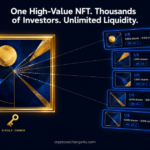
The result: a $500,000 digital artwork that was accessible to one buyer becomes accessible to 5,000 investors at $100 each. Liquidity deepens, price discovery improves, and the asset actively generates market activity rather than sitting dormant. Interested in the underlying token standards? Our team builds on both ERC20 token development and NFT token development standards that power fractional ownership systems.
Why Fractional NFT Platforms Are Gaining Momentum in 2026
The Market Data That Makes the Case
| Metric | 2026 Figure | Growth Signal |
|---|---|---|
| Global NFT market size | $60.82 billion | 41.2% CAGR |
| NFT fractionalization platform market | $234.4 million | 28.1% CAGR to $1.67B by 2034 |
| Institutional NFT deals with fractional structures | 30%+ | Goldman Sachs, JPMorgan piloting tokenized NFTs |
| NFT VC funding deployed | $4.2 billion | Infrastructure investment accelerating |
| RWA-backed NFT market share | 11% | Projected $230B+ by 2030 |
| Gaming NFT transaction volume | 38% of total | Strongest growth subsector |
Three Forces Driving 2026 Momentum
Institutional adoption: Financial giants including Goldman Sachs and JPMorgan are actively piloting tokenized NFTs for digital asset collateralization. Where institutions go, platform infrastructure follows — and fractional ownership is the mechanism that makes high-value NFTs usable as financial instruments. Our cryptocurrency development services are built to meet exactly this institutional-grade standard.
Real-world asset tokenization: Fractional NFT infrastructure has become the primary mechanism for making tokenized physical assets liquid. Real estate, art, luxury goods, music royalties — all are entering the on-chain economy through fractionalization. The RWA tokenization market is projected to exceed $230 billion by 2030, and fractional NFT platforms are the trading layer that makes it all work.
Layer-2 fee reduction: Trading fractional shares on Polygon, Arbitrum, or Base now costs a fraction of Ethereum mainnet fees — making micro-denomination retail participation economically viable in a way that wasn’t practical two years ago. This is what turns a theoretically interesting model into one with genuine retail traction.
Business Models for a Fractional NFT Marketplace
| Revenue Stream | How It Works | Revenue Timing |
|---|---|---|
| Fractionalization fees | Charged when owner splits NFT into shares (% of asset value or flat fee) | Immediate, per asset |
| Secondary trading fees | % of every fractional token trade on the marketplace | Ongoing, compounds with volume |
| Buyout & settlement fees | % of the total acquisition price when full buyout is triggered | High-value, per event |
| Premium listing fees | Asset owners pay for featured/promoted placement | Recurring, scales with platform audience |
| DeFi yield integration | Fractional tokens used as DeFi collateral; platform earns yield share | Passive, scales with TVL |
| Curation & verification fees | Brands and institutions pay for verified asset listings | Per asset, premium tier |
The most durable fractional NFT platforms stack at least three of these revenue streams from launch. Secondary trading fees alone — at even a 1% rate on active markets — compound significantly as the platform’s asset library and user base grows. Platforms that also integrate with NFT marketplace development infrastructure create additional flywheel effects through shared liquidity and user discovery.
The Real Market Scope: Who Actually Uses Fractional NFT Platforms?
Fractional NFTs are not a niche for crypto insiders only. The use cases extend much further:
- Digital art collectors — enabling fractional ownership of blue-chip generative art, photography, and 1/1 artworks valued above $50,000
- Metaverse real estate investors — splitting prime virtual land parcels across investor groups (Decentraland Foundation released an open-source fractional real estate protocol in March 2025)
- Gaming asset owners — fractionalizing rare in-game items, characters, and land from high-value Web3 game development ecosystems
- Music rights holders — tokenizing and fractionalizing royalty streams for fan investment
- Institutional RWA investors — accessing fractional ownership of tokenized physical assets via compliant on-chain infrastructure
- Retail DeFi users — using fractional NFT tokens as collateral in lending protocols
Each of these use cases represents an independently addressable market — and a fractional NFT platform built with flexible asset support can serve multiple segments simultaneously.
Key Technical Architecture: What You’re Actually Building
Fractional NFT marketplace development requires solving several layers of technical complexity that go beyond a standard NFT marketplace build. Here’s what every serious platform needs:
Core Technical Components
- Vault smart contracts: Secure ERC-721 lockup with ERC-20 fractional token issuance, audited for reentrancy and ownership edge cases
- Buyout mechanism: On-chain voting and price discovery system that protects minority holders from forced exits while enabling genuine acquisitions — this is often the hardest part to get right
- Secondary market AMM or order book: Optimized for low-denomination fractional tokens, with liquidity pool management and price feeds
- Cross-chain compatibility: Users expect their fractional tokens to work across Ethereum, Polygon, BNB Chain, and Solana — requiring bridge infrastructure and multi-chain resolver support
- Asset valuation feeds: Real-time price oracles for the underlying NFT assets, critical for accurate fractional token pricing and collateralization
- Governance infrastructure: Token-weighted voting for buyout decisions, platform parameters, and treasury management
- Decentralized storage: IPFS or Arweave integration for NFT metadata and asset provenance records
For platforms building on BNB Chain, our BEP20 token development capability covers the full fractional token issuance layer with EVM-compatible smart contract architecture. For TRON-based deployments, our TRC20 token development team handles TRC-721 vault contracts and TRC-20 fractional token issuance natively.
Fractional NFT Platform vs. Standard NFT Marketplace
| Feature | Standard NFT Marketplace | Fractional NFT Marketplace |
|---|---|---|
| Ownership model | Single owner per NFT | Multiple co-owners via ERC-20 shares |
| Token standards used | ERC-721 / ERC-1155 | ERC-721 (vault) + ERC-20 (fractions) |
| Minimum investment | Full asset price | Any amount (micro-ownership possible) |
| Liquidity | Low (full asset must trade) | High (fractional tokens trade freely) |
| Smart contract complexity | Moderate | High (vault + buyout + AMM + governance) |
| DeFi composability | Limited | High (fractions usable as collateral) |
| Institutional suitability | Moderate | High (structured ownership, audit trail) |
| Development complexity | Medium (3–4 months) | High (4–6 months) |
How to Start Building a Fractional NFT Marketplace
- Define your asset vertical: Digital art, gaming assets, real estate, music rights — each vertical has different valuation, compliance, and liquidity requirements. Picking a focused vertical first is faster to market than building a generalist platform.
- Choose your blockchain stack: Ethereum + a Layer-2 (Polygon or Arbitrum) for maximum liquidity and DeFi composability; BNB Chain for lower cost with EVM compatibility; Solana for speed if gaming assets are your focus. Consider blockchain consulting to model the tradeoffs before committing.
- Design the vault and tokenomics: Define your fractional supply cap, buyout mechanism rules, governance voting thresholds, and fee structure. Tokenomics at this stage determines long-term platform sustainability.
- Build and audit vault smart contracts: This is the most security-critical layer. Vault contracts that hold high-value NFTs must be audited by a third-party firm before any real assets are deposited. Our cryptocurrency development services include audit coordination as a standard part of smart contract delivery.
- Build the secondary marketplace: AMM-based liquidity pools or an order book for fractional token trading, with price feeds and liquidity incentives for early market makers.
- Integrate wallet and onboarding: Support MetaMask, WalletConnect, and ideally social login or embedded wallets for non-crypto-native users entering through RWA or gaming verticals.
- Launch with curated assets: Don’t launch with an empty marketplace. Partner with 3–5 high-quality asset holders to seed the platform with desirable fractional offerings before public launch.
Looking to add an NFT launchpad alongside your fractional marketplace? It’s a natural combination — launchpad for new assets, fractionalization for premium secondary liquidity.
Frequently Asked Questions About Fractional NFT Marketplace Development
What is a fractional NFT marketplace?
A fractional NFT marketplace is a blockchain platform where high-value NFTs are divided into smaller tradeable shares using smart contracts. The original NFT is locked in a vault, and ERC-20 tokens representing fractional ownership are issued and traded freely on the secondary market. It enables multiple investors to co-own premium digital assets without purchasing them outright.
How does NFT fractionalization work?
NFT fractionalization works by locking an ERC-721 NFT in a smart contract vault and minting ERC-20 tokens that represent proportional ownership shares. These fractional tokens are freely tradeable. A buyout mechanism allows collective owners to vote on acquisition offers — if accepted, token holders receive their proportional payout and the original NFT transfers to the acquirer.
How big is the fractional NFT market in 2026?
The NFT fractionalization platform market was valued at $234.4 million in 2026 and is projected to grow to $1.67 billion by 2034 at a 28.1% CAGR. The broader NFT market reached $60.82 billion in 2026, with gaming NFTs alone capturing 38% of total transaction volume.
What are the revenue models for a fractional NFT marketplace?
Fractional NFT platforms generate revenue through fractionalization fees (charged when an NFT is split), secondary market trading fees (percentage of every fractional token trade), buyout and settlement fees (percentage of the full asset acquisition price), premium listing fees, and DeFi yield integration fees from fractional tokens used as collateral.
What blockchain is best for building a fractional NFT marketplace?
Ethereum is the most liquid choice. Layer-2 networks like Polygon, Arbitrum, and Base are preferred for lower gas costs on fractional token trades. BNB Chain (BEP20) offers EVM compatibility with lower fees for high-volume platforms. The right choice depends on your target asset vertical and user geography.
What is the difference between ERC-721 and ERC-20 in fractional NFTs?
ERC-721 is the standard for unique, non-fungible tokens — the original high-value asset being fractionalized. ERC-20 is the fungible token standard used for the fractional ownership shares. The ERC-721 NFT is locked in a vault smart contract, and ERC-20 tokens representing proportional stakes are minted and distributed to buyers.
How long does it take to build a fractional NFT marketplace?
Building a fractional NFT marketplace typically takes 3 to 6 months. A focused MVP with vault smart contracts, fractionalization logic, and secondary trading can launch in 3 months. A full platform with cross-chain support, governance voting, DeFi integrations, and analytics takes 5 to 6 months with an experienced Web3 development team.
At CryptoExchange4U (powered by Gegosoft), we build fractional NFT marketplaces and Web3 trading platforms from the ground up — vault contracts, fractionalization logic, secondary markets, governance systems, and cross-chain compatibility all designed to work together from day one. If you’re ready to explore building a fractional NFT platform, start a consultation with our development team and let’s map out the full architecture for your project.
Related reading: NFT Domain Platform Development in 2026 | Web3 Game Development in 2026 | SocialFi Platform Development in 2026






0 Comments