
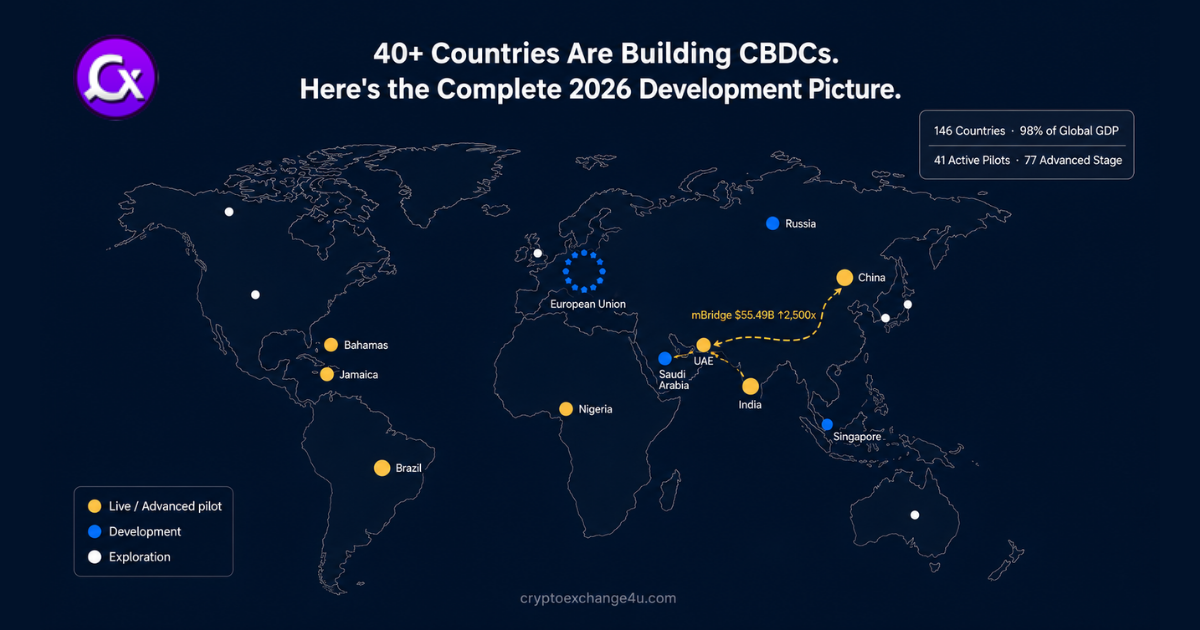
CBDC platform development is the process of building government-grade digital currency infrastructure — core ledger, wallet systems, payment rails, KYC/AML compliance, and cross-border interoperability — for a Central Bank Digital Currency. As of May 2026, 146 countries representing 98% of global GDP are actively exploring CBDCs, with 41 pilot projects live and a new high of 77 countries in advanced development phases.
The global financial system is undergoing a structural upgrade — and it’s happening faster than most people outside central banking circles realize. The question of whether governments will issue digital currencies has already been answered. The question now is how they’ll be built, what technical architecture will power them, and which development teams have the expertise to deliver infrastructure that operates at national scale.
As of May 2026, 146 countries and currency unions representing over 98% of global GDP are exploring a CBDC. There are currently 41 CBDC pilot projects around the world, with a new high of 77 countries in the advanced phase of exploration — including development, pilot, or launch. For blockchain entrepreneurs and development firms evaluating where the next major infrastructure opportunity lies, CBDC platform development is one of the clearest signals in the market.
Here’s what the landscape actually looks like in 2026, what building a CBDC platform involves, and what entrepreneurs need to understand about this space before entering it.
What Is a CBDC — and Why Are 146 Countries Building One?
A Central Bank Digital Currency (CBDC) is a digital form of a country’s official fiat currency, issued and regulated directly by the nation’s central bank. Unlike cryptocurrencies such as Bitcoin or Ethereum, CBDCs are not decentralized — they carry the full backing and legal tender status of the issuing government. Unlike commercial bank deposits, they represent a direct claim on the central bank itself.
The motivations driving 146 governments toward CBDC development vary significantly by region — but several forces are consistent across markets:
- Financial inclusion: 44% of emerging economies are deploying CBDCs to enhance financial inclusion through programmable payments, and 58% of governments in developing nations are using CBDCs for government-to-person (G2P) payments.
- Cross-border efficiency: Traditional international transfers take 3–5 days and cost 6% in fees. CBDC cross-border platforms like mBridge settle transactions in seconds at near-zero cost.
- Dollar alternative: BRICS countries have actively promoted developing alternate payment systems to the dollar, and many members are building cross-border wholesale CBDCs. India, as host of the 2026 BRICS summit, has proposed linking member states’ digital currencies to facilitate cross-border trade.
- Stablecoin competition: Emerging markets such as Rwanda, Kazakhstan, and Bolivia are investing in retail CBDC development in response to the rapid proliferation of dollar-backed stablecoins.
The 2026 CBDC Landscape: Where Every Major Economy Stands
| Country / Region | CBDC Name | Status (2026) | Key Milestone |
|---|---|---|---|
| China | e-CNY (Digital Yuan) | 🟢 Advanced Pilot | 3.4B+ transactions, ~$2.3T value processed; 1.8B wallets across 26 cities |
| India | Digital Rupee (e₹) | 🟢 Active Pilot | 7 million retail users; programmable pilots for direct benefit transfers |
| Brazil | Drex | 🟢 Limited Launch | Entered limited public deployment January 2026 with tokenized asset settlement focus |
| UAE | Digital Dirham | 🟢 Launched (March 2026) | Officially launched March 2026; enables cross-border transfers with Saudi Arabia, India, and China at near-zero fees |
| Russia | Digital Ruble | 🟡 Mass Launch Sept 2026 | Systemically important banks required to connect clients to digital wallets; major retailers must accept digital ruble payments |
| European Union | Digital Euro | 🟡 Preparation Phase | ECB estimates €1.3B development costs; pilot transactions planned 2027; first issuance targeted 2029 |
| Bahamas | Sand Dollar | 🟢 Fully Launched | First fully launched retail CBDC globally |
| Nigeria | eNaira | 🟢 Fully Launched | One of only 3 fully live retail CBDCs worldwide |
| Jamaica | JAM-DEX | 🟢 Fully Launched | Third fully operational retail CBDC globally |
| mBridge (Multi) | Cross-Border CBDC | 🟢 Active | Transaction volume surged to $55.49 billion — a 2,500-fold increase since early 2022 pilots |
Every G20 country except the United States is exploring a CBDC, with 18 of them in the advanced stages of exploration and 14 G20 members now in the pilot phase. The US remains an outlier — but the New York Fed continues wholesale cross-border research through Project Agorá.
Retail vs. Wholesale CBDCs: The Two Architecture Tracks
| Dimension | Retail CBDC | Wholesale CBDC |
|---|---|---|
| Who uses it | Households and businesses (everyday payments) | Financial institutions and central banks (interbank settlement) |
| Primary use case | Payments, G2P transfers, financial inclusion | Cross-border settlement, tokenized assets, securities |
| Architecture priority | Scalability, offline capability, UX, privacy | Finality, programmability, interoperability |
| Distribution model | Intermediated (via commercial banks and fintechs) | Direct central bank to institution |
| Key technical challenge | Handling millions of concurrent low-value transactions | Cross-border interoperability and atomic settlement |
| Current trend | Emerging markets doubling down; advanced economies retreating | Growing globally — ECB, Singapore, Brazil all building |
| Examples | e-CNY, eNaira, Sand Dollar, Digital Rupee | mBridge, Project Pontes (ECB), Singapore wholesale CBDC |
Developing wholesale infrastructure has become the focus for central banks exploring a CBDC. The ECB’s Project Pontes, Singapore’s live wholesale CBDC issuance, and Brazil’s Drex tokenized credit pilot all represent a push to upgrade how central bank money moves between institutions, with a focus on tokenization and programmability.
The Technical Architecture of a CBDC Platform
CBDC platform development is fundamentally different from building a standard blockchain application. The infrastructure must operate at national scale, meet regulatory mandates, interface with existing banking systems, and maintain performance under the transaction volumes of an entire economy. Here are the core layers every CBDC platform requires:
Core Technical Components
- Core ledger layer: Most CBDC projects use permissioned distributed ledger technology (DLT) — Hyperledger Fabric, Corda, or custom stacks — rather than public blockchains. Brazil’s Drex and Singapore’s wholesale CBDC are exploring EVM-compatible architectures for tokenization composability. China’s e-CNY uses a proprietary centralized ledger optimized for throughput.
- Wallet infrastructure: Two-tier wallet systems — institutional wallets for commercial banks, retail wallets for end users — with hardware security module (HSM) integration for key management. Offline payment capability is required in most retail CBDC mandates for financial inclusion in low-connectivity regions.
- Payment rails: Real-time gross settlement (RTGS) integration for high-value transactions; instant retail payment rails for consumer use. Both must interoperate with existing national payment infrastructure — SWIFT, domestic ACH systems, and central bank RTGS platforms.
- KYC/AML compliance modules: Identity verification tied to national ID infrastructure, transaction monitoring for suspicious activity, and tiered KYC — lighter requirements for low-value wallets, full KYC for higher transaction thresholds. This is where our cryptocurrency development services including KYC/AML integration deliver direct value to CBDC infrastructure projects.
- Programmability layer: Smart contract functionality enabling conditional payments — G2P benefit payments that can only be spent on eligible categories, time-locked disbursements, and automated compliance triggers. This is where token development expertise translates directly into CBDC infrastructure.
- Interoperability protocols: Cross-border CBDC connectivity through platforms like mBridge, Project Agorá, and bilateral corridors. Technical standards for atomic cross-currency swaps without correspondent banking intermediaries.
- Privacy architecture: Balancing transaction transparency for compliance with user confidentiality. Most CBDC designs adopt a “privacy by design” approach — transaction data visible to regulators but not commercially exploitable.
The CBDC Development Roadmap: Phase by Phase
- Research and feasibility (6–12 months): Define the policy objective — financial inclusion, cross-border efficiency, cash replacement, or programmable payments. Assess existing payment infrastructure. Choose between retail, wholesale, or hybrid CBDC design. Evaluate DLT options against centralized database models based on transaction volume requirements and decentralization mandate.
- Architecture design and prototyping (3–6 months): Design the two-tier distribution model. Prototype the core ledger and wallet system. Define privacy architecture and KYC tier structure. Build initial smart contract templates for programmable payment use cases. Engage with commercial bank partners for the intermediated distribution layer.
- Pilot development and closed testing (12–18 months): Build production-grade ledger infrastructure. Develop retail wallet apps for iOS and Android. Integrate with national payment rails and commercial banking APIs. Conduct closed pilot with select financial institutions and user groups. Run performance and stress testing against projected national transaction volumes.
- Regulatory approval and compliance certification (3–6 months): Achieve central bank sign-off on security architecture. Complete third-party security audits. Obtain regulatory approvals for digital legal tender status. Finalize data governance and privacy policy compliance.
- Phased public launch (12–18 months): Staged rollout — city or region first, then national expansion. Commercial bank onboarding for wallet distribution. Public communications and financial literacy campaign. Real-time monitoring and incident response infrastructure. Continuous iteration based on adoption data.
- Cross-border interoperability (ongoing): Connect to multilateral CBDC platforms — mBridge, Project Agorá, bilateral corridors. Negotiate technical standards with partner central banks. Enable atomic cross-currency settlement for trade and remittance corridors.
The Market Opportunity for CBDC Development Teams
The scale of investment flowing into CBDC infrastructure is significant and still accelerating. The ECB alone estimates total digital euro development costs at approximately €1.3 billion until first issuance, with annual operating costs near €320 million from 2029. Multiply that across 77 countries in advanced development phases and the total infrastructure spend becomes one of the largest blockchain development opportunities of the decade.
The opportunity isn’t limited to working directly with central banks. The CBDC ecosystem creates demand for a broader set of infrastructure components that private-sector blockchain teams can build and supply:
- Retail wallet applications for commercial banks distributing CBDC to end users — this is squarely within the scope of our cryptocurrency e-wallet development capabilities
- KYC/AML compliance tooling tailored to CBDC transaction monitoring requirements
- Smart contract programmability modules for G2P payments, conditional disbursements, and tax compliance automation — areas where ERC20 token development and BEP20 token development expertise maps directly to CBDC programmability requirements
- Cross-border settlement infrastructure connecting national CBDC platforms — a natural extension of white label cryptocurrency exchange software to sovereign digital currency corridors
- CBDC analytics and monitoring dashboards for central bank operations teams
- Merchant acceptance infrastructure — POS systems, payment APIs, and e-commerce integrations that accept CBDC alongside traditional payment methods. Our existing cryptocurrency buy/sell platform architecture provides a foundation for exactly this.
CBDC vs. Cryptocurrency: The Key Distinctions
| Property | CBDC | Cryptocurrency (e.g. Bitcoin) |
|---|---|---|
| Issuer | Central bank / government | Decentralized protocol / miners |
| Backing | Full faith and credit of the state | Market demand / protocol rules |
| Supply control | Controlled by monetary policy | Algorithmically fixed or governed |
| Privacy | Regulated — central bank visibility | Pseudonymous to fully private |
| Programmability | Conditional — policy-governed | Open — permissionless smart contracts |
| Legal tender status | Yes — by government mandate | No (except El Salvador, CAR) |
| Technology base | Permissioned DLT or centralized DB | Permissionless public blockchain |
| Interoperability | Bilateral / multilateral government agreements | Open cross-chain protocols |
Understanding these distinctions matters for development teams because CBDC architecture decisions are driven by policy requirements — not by decentralization ideals. A blockchain developer who understands why a central bank chooses permissioned DLT over a public chain, and can translate that into technical architecture, is far more valuable to a CBDC project than one who only builds in the open Web3 ecosystem. Need a strategic consultation on how your blockchain infrastructure maps to CBDC requirements? Our blockchain consulting team works through exactly these architecture decisions.
Frequently Asked Questions About CBDC Platform Development
What is CBDC platform development?
CBDC platform development is the process of building the technical infrastructure for a Central Bank Digital Currency — including the core ledger, wallet systems, payment rails, smart contract programmability layer, KYC/AML compliance modules, and interoperability protocols required for a government-backed digital currency to function at national scale.
How many countries are developing CBDCs in 2026?
As of May 2026, 146 countries and currency unions representing over 98% of global GDP are exploring a CBDC. 77 countries are in the advanced phase of exploration — including development, pilot, or launch — and there are 41 active CBDC pilot projects worldwide. Three countries have fully launched retail CBDCs: The Bahamas, Jamaica, and Nigeria.
What is the difference between a retail CBDC and a wholesale CBDC?
A retail CBDC is designed for everyday use by households and businesses — everyday payments, G2P transfers, financial inclusion. A wholesale CBDC is designed for financial institutions, functioning similarly to central bank reserves for interbank settlement and cross-border transactions. Most current advanced projects involve both tiers, with distinct technical architecture for each.
What blockchain technology is used for CBDC development?
Most CBDC platforms use permissioned distributed ledger technology (DLT) — Hyperledger Fabric, Corda, or custom stacks — rather than public blockchains. Brazil’s Drex and Singapore’s live wholesale CBDC issuance are exploring EVM-compatible architectures for tokenization composability. China’s e-CNY uses a proprietary centralized ledger optimized for throughput at massive scale.
What is the largest CBDC project in 2026?
China’s e-CNY is the world’s largest CBDC pilot, with 1.8 billion wallets issued across 26 cities and monthly transaction volume exceeding $28 billion. The mBridge cross-border CBDC platform processed $55.49 billion in transactions — a 2,500-fold increase since early 2022 pilots.
How long does it take to develop a CBDC platform?
CBDC platform development typically follows a three-phase roadmap: research and design (6–12 months), pilot development and testing (12–24 months), and phased public deployment (12–18 months). End-to-end, most national CBDC projects run 3–5 years from initiation to live retail launch. The ECB estimates €1.3 billion in total development costs for the digital euro.
What are the key technical components of a CBDC platform?
A CBDC platform requires: a core ledger (DLT or centralized database), retail and institutional wallet infrastructure, real-time payment rails, KYC/AML compliance modules, a smart contract programmability layer, offline payment capability, cross-border interoperability protocols, and a privacy architecture balancing regulatory transparency with user confidentiality.
CBDC infrastructure is one of the most technically demanding — and strategically significant — categories in blockchain development right now. At CryptoExchange4U (powered by Gegosoft), we build the blockchain infrastructure components that feed directly into CBDC ecosystems: smart contract programmability layers, KYC/AML compliance modules, cryptocurrency wallet systems, and payment exchange infrastructure. If you’re working on a CBDC-adjacent project — whether a retail wallet, a compliance module, a cross-border settlement layer, or a merchant acceptance platform — start a consultation with our development team and let’s scope the architecture together.
Related reading: DePIN Platform Development in 2026 · Web3 Game Development in 2026 · SocialFi Platform Development in 2026












0 Comments